pondelok 17. septembra 2018

MDA from Bromosafrole using PTC and an azide

This file is a part of the Rhodium site archive. This Aug 2004 static snapshot is hosted by Erowid
as of May 2005 and is not being updated. > > Back to Rhodium Archive Index > >

MDA from Bromosafrole
using a PTC and an azide intermediate

by Ritter

HTML by Rhodium

Procedure1

A mixture of 2-bromosafrole (24.1g, 0.1mol), hexadecyltributylphosphonium bromide (5.1g, 0.01mol), sodium azide (16.2g, 0.25mol), and water (50ml) is magnetically stirred at 80°C for 24 hours. Flask is cooled and phases are separated in sep funnel. The dark reddish organic layer is diluted with toluene (20ml) and poured back into flask and stirring is restarted. A solution of sodium borohydride (11.7g, 0.3mol) in water (30ml) is carefully added through an addition funnel over 30 minutes as temp is raised to 80°C and held there for 16h. Contents of flask are cooled and poured into a sep funnel. Aqueous layer is sepped off and organics are washed with 50ml dH2O. Three 40ml portions of 4M HCl (approx 10%) are used to extract MDA base from organic layer. Combine all acid extracts and neutralize with 50% NaOH soln. Golden beads of MDA base will fall out of soln. Use two portions of 50ml toluene to isolate base. At this point one of two things can be done. If you are a greedy shoddy chemist you will dry the toluene extracts with anhydrous MgSO4 then bubble with HCl gas to isolate a relatively pure white MDA hydrochloride (8-12g) OR if you have any pride in your chemistry skills and product, toluene will be evaporated down to a orange oil and vacuum distilled using standard methods to yield 6.5-11.0g of water white pristine MDA base. Distilled base is most easily crystallized by adding about 6 times volume of dry IPA and neutralizing w/ conc. HCl. Place this in the freezer over night to find glorious white crystals of the hydrochloride. At this point not all of the salt has precipitated and it won't no matter how long you leave it in the freezer, so add the same volume of dry acetone to ppt. entire yield (6-12g, or 27-56% yield from bromosafrole).

Notes:

  1. 2-Bromosafrole was prepared using process developed by Fester. HCl(g) is bubbled into a soln of 48%(aq)HBr, HOAc and PURE DISTILLED safrole. The procedure is archived on Rhodiums site and runs exactly as Fester claims, believe it or not!
  2. Yield of product is totally dependant on reaction time/temp of first step. If literature citing is examined yields above 85% are reported for all primary alkyl bromides. Problem with lower yield here is the fact that we are dealing with a secondary bromide. This introduces the possibility of occurrence of two yield killing side reactions. Elimination of -Br resulting in isosafrole then elemination of azide may occur resulting in more isosafrole. Perhaps reducing the temp and extending rxn time will slow rate of elimination resulting in higher yield of alkylazide. Someone willing to try?
  3. Chlorosafrole does not work satisfactorily at all in this procedure. If you want to use that as a starting material, first perform a Finkelstein swap with NaI in acetone to form Iodosafrole, which is as reactive as Bromosafrole using this method.
  4. The PTC suggested in the original reference1 (hexadecyltributylphosphonium bromide) is very expensive. Substituting an equimolar amount of Aliquat 336 (3.4g, 0.01 mol) in the procedure above is a cheaper alternative, and gives comparable results.

Synthesis of MDE from 2-Azidosafrole

by Foxy2
Instead of extracting the azide with toluene use xylene. Use a well dried xylene extract in the following procedure.

Example using cyclopentyl azide2

In a dry 50ml flask equiped with septum inlet, reflux condenser, and magnetic stirrer was flushed with nitrogen. The flask was charged with 10mL xylene and 0.98g, 1.42ml (10 mmol) of triethylborane. The solution was then heated to reflux and attached to a gas buret. Then 1.11g (10 mmol) cyclopentyl azide was added. After completion of nitrogen evolution, the flask was cooled, 30 ml diethyl ether was added and the amine extracted with 6 M HCl, two 20 ml portions. The aqueous phase was then washed with ether to remove residual borinic acid. Yield 77%.

Synthesis of MDMA from 2-Azidosafrole

by Ritter
This reference is a significant advance in alkylazide reduction techniques because it reduces the azide and methylates it in one single step. This is the only ref I am aware of which yields a N-methylamine directly from the azide precursor without using catalytic hydrogenation for the reduction.

Sample procedure3

Secondary alkylazide (0.148mmol) in CH2Cl2 (1.5ml) was added a solution of (CH3)3P in toluene (1.0M, 0.3mL) at room temp. After stirring for 1.5hr, paraformaldehyde (22.6mg, 0.753mmol) was added. The rxn. mixture was stirred for an additional 6hr at room temp then rxn was cooled to 0°C and MeOH (2.0ml) and NaBH4 (28mg, 0.74mmol) was added. After stirring for 30 min the rxn. was quenched with saturated aq. NaHCO3 and extracted with 5×10ml CH2Cl2. Extracts were pooled and evaporate to yield 83% N-methylamine.

References

  1. J. Org. Chem., 47, 4327
  2. The reaction of organic azides with triethylborane. A new route to secondary amines. J. Am. Chem. Soc. 93, 4329-4330 (1971)
  3. Convenient Procedure for One-pot Conversion of Azides to N-monomethylamine, Synlett 1003-1005 (2001)

Complete MDMA Synthesis by Dr Drool

This file is a part of the Rhodium site archive. This Aug 2004 static snapshot is hosted by Erowid
as of May 2005 and is not being updated. > > Back to Rhodium Archive Index > >

A Working MDMA (Ecstasy) Synthesis

By Doctor Drool

HTML by Rhodium

MDMA Synthesis Story

What follows is, of course, a work of pure fiction. In it, I have tried to illustrate something of the mental state of an individual whose mind was severely altered when he took his first dose of ecstasy and decided that he would love to take more. Doctor Drool, the protagonist, was paranoid about taking street drugs, but was quite confident of his own abilities in a chemistry lab, although he had not exercised those abilities for 20 years. He was moderately well trained in chemistry in the university (two full years of inorganic and organic classes with labs), but he had not done or even thought about lab work for many years.
The manufacture of ecstasy is, of course, totally illegal and degenerate, and the author feels that anyone who tries to do it should be hauled in front of John Ashcroft's military tribunals and then executed (or executed first; it doesn't really matter).
Although in the story that follows, the protagonist has so far avoided arrest and execution, I'm certain that he will receive the punishment he deserves any day now.
Any relationship between the methods described by Doctor Drool and reality are, of course, completely coincidental, but to make the story more believable, I have included text from actual web pages, perhaps written by real degenerates, not like the fictional Doctor Drool.
I hope you enjoy the story. If it keeps just one person from falling into the hell of ecstasy (or, as the addicts sometimes call it, "rolling" on MDMA, ADAM, E, X, or XTC), it will have been worth the effort of writing.
-- the author, Feb 25, 2002

Introduction:

I initially tried to follow the BrightStar synthesis that I found on the internet but the only part that was reasonable was for the distillation of safrole from the raw sassafras oil. It was, however, good to read BrightStar's description just to remind myself about some chemistry techniques that I hadn't done for 20 years. I later found other syntheses on the internet for all the steps between legal chemicals and MDMA that worked quite well.
At least at the current time (early 2002), all the chemicals and apparatus mentioned here are available legally. Aside from the ecstasy, of course, the only other intermediate products that you will produce along the way that are at the least highly suspicious are the pure, distilled safrole and the ketone MDP-2-P. The unfortunate thing about the ketone is that although you probably have a million good places to hide the ecstasy and the safrole, the MDP-2-P must be kept in the freezer. The folks from the DEA know this. Luckily, the ketone is only necessary for the final synthesis, so I made it just before I needed it, and then repeated the final step until the ketone was all used up. Now when the DEA breaks down my door, they've got to find less than an ounce of white powder (maybe I should label it "anthrax") in an unknown form rather than find a little jar of antifreeze-colored green fluid in my freezer.
Make certain that you have (or know you can obtain) all of the stuff (chemicals and apparatus) before you begin. For example, at the time BrightStar wrote his synthesis, it may have been easy to obtain dimethylformamide; now, it is not. If you decide to embark upon this project, it is not going to be cheap, assuming you're starting from scratch. I spent perhaps $1100 total -- $800 for lab supplies (glassware, hotplate-stirrer, clamps, stands, vacuum pumps, et cetera), and $300 for chemicals. If I decide to do it again, it'll probably cost me another $200 (and I'll get a lot more product the second time).
My overall impression is that the synthesis is moderately difficult, at least for someone who last took an organic chemistry lab course more than 20 years ago. I was quite good in the labs back then, and also understood the chemistry quite well. I took the time to understand to a pretty good degree the chemistry in this synthesis. The more anal-compulsive you are, the better you'll do. Study the reactions. Understand how they work. Although it would seem that you could just follow a cookbook method, it's amazing how much better that works when you know exactly what you are doing and why you are doing it.
If I had tried this synthesis without experience with organic chemistry laboratory techniques, I have severe doubts that I'd have been able to pull it off. If you are without experience but would still like to try, remember that most junior colleges offer lab courses in organic chemistry. Take one of those and concentrate on getting an A+ in the lab part.

Overall notes:

(This stuff is in no particular order -- there may be more important stuff following less important stuff.)
This process is going to take a long time. Even if you had all the stuff you needed, it takes a few days. There are lots of long waits for reactions to proceed, and you'll find you need to go shopping for things you forgot. Also, what I tended to do is when I got a particular step to work, I'd rerun that reaction a bunch of times in a row to make a lot of the product for future steps. If you run a reaction the next day, you'll remember everything about it. And you will make mistakes in the later steps, destroying some of your intermediate product, so it's nice to have made enough to be able to recover and try again right away. The BrightStar synthesis led me to believe that the entire process might just take a couple of long days. I think it took me a month between purchasing the first chemical and "rolling" for the first time on my own stuff. I hope these notes will reduce your time significantly.
You can check yourself as you go along. For example, if the boiling points of your intermediate products are wildly out of line, you've screwed up. Note the expected colors, consistency, et cetera. One of the referenced documents on the web contains photos from the final production of MDMA from the ketone and nitromethane. They don't look very appetizing (other than the final photo of beautiful, brilliant, white crystals), but it's great to know that your gunk looks exactly like his gunk. You're going to eat the stuff later, right? Almost all the precursors are poisonous, right? You really would prefer to make something "edible", wouldn't you?
The scariest part, perhaps, is your first test of your first final product, unless you happen to have a mass spectrometer or an NMR in your basement (I don't). Luckily, I had tasted real MDMA previously, so I could taste the tiniest grain of my final product. Even though MDMA tastes pretty shitty, when my stuff tasted the same as the real stuff, it was the best-tasting thing in the world! Then, if you've got good sense, try a little bit for your first real dose -- perhaps a quarter of what you normally take (100 or 125 mg is a "normal" dose, depending on your weight, susceptibility, et cetera). Then try a half dose, then the whole thing.
I have seen "test kits" available that are presumably used to test street drugs to make certain that they're what they were sold as. I think that at least most of them are not highly specific tests; they simply indicate that the chemicals are in some general class. This might be good enough to tell you that the MDMA you bought is really speed or LSD in place of ecstasy, but if you've made the stuff yourself, it's pretty unlikely that you'll have speed or LSD in your final product by accident. Your precursors are all MDMA precursors, so the test kit is far more likely to "see" MDMA-like chemicals than other stuff, even if you totally screwed up. So it probably wouldn't hurt to run one of these tests, but it won't tell you for sure, and it certainly won't give you any indication of the purity.
I am completely paranoid, so, except for the totally safe reactions (and the way you'll know which ones are safe is by studying the reactions), I kept a fire-extinguisher handy. The only reaction that scared the shit out of me was the distillation of the nitromethane from the RC fuel. I did it outdoors, and for that one had the pin pulled on the fire extinguisher all the time.
Also, wear old clothes, with long sleeves, long pants, shoes and socks, and you might want to use rubber gloves when you're working with the highly corrosive stuff like muriatic acid, sulfuric acid, and sodium hydroxide. Safety glasses (or at least regular glasses, if you wear them) are a good idea for many steps. Although I thought I was being careful, I was not highly amused after working with the concentrated NaOH solution to find about a hundred tiny holes in my pants after washing them. I apparently splattered them with NaOH, and it ate a bunch of little holes...
I spent perhaps $300 on chemicals and, including a whole bunch of errors, made about 60 grams of pretty pure ecstasy. That's 600 doses of 100 mg. At $20 per dose, that's $12,000 worth. If you scrimp on the chemicals, perhaps you'll spend only $200, but a likely result is that you will then get $0 worth of ecstasy. The $100 savings nets you a $12,000 loss. I'm not much of a businessman, but that seems like a bad deal to me...
Get the right stuff if you can. Buy real dichloromethane (methylene chloride); don't mess with the Jasco stripper, since it's got alcohol and God knows what else in it. Use distilled water -- you can get it for a couple of bucks at the grocery store (or make it yourself, since you've got distillation glassware anyway). Get technical grade methanol, xylene, et cetera. You may spend an extra $100, but, again, that's just 5 doses of ecstasy. I used stuff like baking soda (NaHCO3), Salt (NaCl), epsom salts (MgSO4·7H2O), et cetera, right from the grocery store or drugstore.
You can get a lot of the chemicals from mail order, Ebay, et cetera, but you will probably have to face some humans to buy stuff that's slightly suspicious. Don't volunteer stories of why you need them for your kid's science fair experiment -- just say nothing. It's good to have in mind some legal uses, but they won't ask. Don't get everything at once for two reasons. First, a complete grocery list for MDMA precursors is pretty suspicious, and second, the DEA in the US requires that large (over $100) purchases of chemistry supplies be reported to them. I got little bits everywhere, and made three trips to the lab supply place to get all my precursors (only two trips would have been necessary to keep the bills under $100 each, but, par for the course, I fucked up).
The main reason to go to a lab supply place is for the stuff that it's a pain to mail-order because of shipping constraints. Things like xylene are highly flammable, so it's much easier to get a gallon of that at the lab place than to hassle with the shipping. Similarly, muriatic acid is easy to get from a pool supply store, and get the nitromethane (mixed with methanol and castor oil) at a hobby shop.
Here's an idea I didn't use but you might: At the lab supply place, ask for the safety sheets on one or two of the chemicals. They're required to have them, and for some reason people think that if you're at all interested in safety then you're not the total degenerate that you really are.
Even when you're not at the lab supply, it feels "safer" if you know the lingo. At the pool supply place where you get the hydrochloric acid, don't ask for "hydrochloric acid"; ask for "muriatic acid". That's what pool people call it. God knows why. Similarly, in the hardware store, ask for "DampRid", not "anhydrous calcium chloride".
I know it feels like the time you were 16 years old and went into the drugstore to get "some chewing gum, some lifesavers, ..., oh, and a package of condoms", but you'll get over it.
Have enough ice on hand for the job. Again, ice is relatively cheap, so get an extra bag for each session. It's a royal pain in the ass to run out in the middle of some critical process. In addition to running ice water through the condenser for distillations, I also used ice in the bucket I used to recycle water through the aspirator. Ice water makes for a better vacuum, and the better the vacuum, the better your vacuum distillations will work. Remember that even when you are just using ice to cool a reflux column, you sometimes need to cool it for up to eight hours.
Work in a ventilated area or under a fume hood (since none of us have fume hoods in our houses, that means a ventilated area), especially when you're working with the stuff like the xylene, acetone, and especially with the HCl gas. In fact, do those outside if you can (definitely outside with the HCl). Look -- you're planning on causing enough brain damage as it is with the ecstasy; why add to it with xylene brain damage that doesn't even make you feel good?
Be patient -- for example, remember that every couple of drops of MDP-2-P that you toss away is a dose (perhaps a $20 street value) of ecstasy. When you're doing the separations, wait for the stuff to settle out properly, or you're throwing good stuff away. While you're waiting for a separation, I'm sure there's some glassware you can clean! And do use very clean glassware!
Get silicone grease to seal the distillation joints during vacuum distills. Make certain it's well sealed. If you turn on the pump and it leaks, turn off the pump, re-seal, and restart. If you don't, you're throwing away good stuff (or possibly toasting it, which is far worse). Brightstar, for example, recommends vaseline, instead of the silicone grease but I figure why not shell out a couple of bucks more and get exactly what works best.
If you screw up, don't continue without correcting the problem. Don't just assume that some of that brown gunk is what you wanted in spite of the fact that the instructions here say that you should be getting a bunch of brilliant white crystals. Before you start a process, be sure you know exactly how to do it. Read an organic lab techniques book on the subject -- it's amazing what you can learn and how much you can retain when you're sufficiently motivated.
If you are the least unsure, do a dry run before you commit the real chemicals. For example, just put water into the system and go through the motions the first time. I don't know what you'll learn, but I'm sure you'll learn something. I did a distillation of eugenol from oil of cloves just to make sure I knew how to do a vacuum distillation of an oil with a high boiling point before I committed my precious sassafras oil. You can get oil of cloves easily from a drugstore, and it's easy to look up boiling points of eugenol, et cetera. Similarly, if you've never used a separatory funnel, pour in some water and oil, shake it up, and then separate those. You'll learn to control the valve, you'll learn whether the valve needs greasing with silicone grease, you'll learn about venting, et cetera.
Be sure to get a good collection of jars that are easy to pour from. It's a giant pain to try to pour fluid from a jar and have it dribble all over your hands. (Guess how I learned this?) The Pyrex measuring cups are great for pouring. Some jars are; some aren't. Check them by pouring water from them before you put in stuff that you care about.
Beware of breaking the plug on the separatory funnel. If you're staring at the liquid and don't have your hand on the plug and the pressure builds up, it's certain to pop out when you're carrying it over a concrete floor. (Guess who broke his?) In fact, the glassware is all moderately delicate, so try to do anything you can to avoid putting it at risk. If you really are just beginning, hook up your various glassware arrangements over a soft bed the first time. Make sure stuff is securely clamped. Pay attention!
Read everything you can before you start. I read and re-read the entire synthesis many times, and then before I started any single step, I re-read it again, and kept a copy next to me as I worked. Notice that there are plenty of things you can do ahead of time -- make aluminum foil balls, "cook" MgSO4·7H2O (epsom salts) to make an anhydrous powder, et cetera.
Don't be in a hurry, especially for the last couple of steps. If you screw them up, you waste ALL your work. If you're going to be sloppy, do it at the beginning so you don't waste too much of your effort :^)
After I got the first working batch, I confess that I did the second batch in a "modified" state of mind, and it worked fine. I was able to keep everything in mind and under control, and, if anything, was able to concentrate better on what I was doing.

Stuff you'll need:

(I may easily have left something off this list; be sure to read the individual parts of the synthesis.) The recommended amounts below allow for a bunch of mistakes. Believe me; you'll make them. I started with a quart of sassafras oil, just to give you the scale, and used about 2/3 of it.

Chemicals:

  • Sassafras Oil: this is about 80-90% safrole. Look for aromatherapy supplies. You can get it on the web. Be sure to get 100% sassafras oil -- don't get it mixed with anything else. It's about $45 per quart, and a quart is vastly more than you'll need, but I'd get at least a half quart (I guess that's a pint).
  • MeOH (methanol, wood alcohol): I got mine from a lab supply house, technical grade. I'd get a gallon or two to account for fuck-ups. Maybe you can get it at drug stores, but all I've seen there is denatured ethanol and isopropyl alcohol. I eventually used two gallons.
  • Distilled H2O: Distill it yourself, or get it at the grocery store. You'll need a few gallons (perhaps 5 or 6) by the time you're done. Get distilled water, not "spring water" or some other such shit.
  • p-Benzoquinone: Get this from photography supply shops. I got a pound and had plenty for a lot of trials.
  • Palladium(II)chloride (PdCl2): Photography supply shops. This is expensive stuff ($25/gram). I got 5 grams total. Get exactly this -- not a replacement or a mixture of this and something else. You can do it 1 gram at a time, but the "recipe" below calls for 2. If you only have 2 grams, do two 1-gram batches.
  • DCM (methylene chloride; dichloromethane): I got it from a chemical lab supply house, technical grade. I used less than a gallon.
  • Xylene: Chemical supply house. I used technical grade, and eventually went through an entire gallon.
  • Acetone: It's with the paint thinners in a hardware store. I got a gallon and it was more than enough. Mostly, I used it to wash and dry glassware, but you also need a little bit for the final wash of the sacred chemical.
  • NaCl (non-iodized table salt): grocery store. Be certain it's not iodized. I don't know what the iodine would do, but I have a healthy imagination, and none of the things I could imagine were good. I think almost all salt (maybe not kosher salt) contains sodium aluminum silicate. Mine did, and that didn't seem to cause any problems. It's cheap -- get three pounds.
  • NaHCO3 -- Sodium bicarbonate (baking soda): grocery store. One big box is plenty.
  • NaOH (lye): I used Red Devil lye from a grocery store (drain cleaner). Get pure, dry lye. Not Drano with the little aluminum flecks, or anything that's already dissolved. Get three or four cans of the stuff.
  • HCl (hydrochloric acid, muriatic acid): Get this from a pool supply place. I got a gallon, and it was far more than enough. It's cheap. Get a gallon or two.
  • MgSO4·7H2O -- Magnesium sulfate: These are epsom salts. Get them at a drugstore. You'll need to cook it to get rid of that "·7H2O". I bought the amount that fits in a container that's the size of a half-gallon milk carton.
  • Nitro RC fuel: From a hobby shop that sells fuel for the RC models. I got a gallon for around $30, and it was far more than I needed. Get the highest concentration you can. The best I found was (supposedly) 40%. It's a mixture of nitromethane, methanol, and something like castor oil. I hear that even higher concentrations are available. The kid that sold me the 40% stuff seemed really concerned that I'd ruin my model airplane engine using such a high concentration. I assured him that I'd dilute it with some methanol -- yeah, right.
  • Aluminum foil: I used the "extra heavy duty" Reynolds wrap. One roll from the grocery store is plenty. Apparently the stuff called "heavy duty" also works, but I assume the reaction will run faster (and hotter and scarier) with it. Everybody cautions against the regular foil. It is just too thin, and believe me, you don't want to see that reaction "run away". It barrels along at a pretty heart-stopping rate even with the extra heavy duty stuff.
  • Peanut oil: Grocery store. Get a couple of quarts.
  • Safflower oil: Grocery store. A little bit; all you need is a few ounces. Be sure to get the stuff with NO ADDITIVES since it's going to get hot and be mixed with something you eventually eat!
  • HgCl2 (mercuric chloride): From a photo chemical supply place. You don't need much -- 3 or 4 grams is plenty. I think I got an ounce and used only a tiny amount. Maybe there's some way I can feed the rest to certain politicians. Careful: this stuff is REALLY poisonous.
  • Sulfuric Acid: I used the high-powered drain cleaner. I got it from a hardware store. I used less than a quart. I don't need to say "be careful", do I?
  • CaCl2 (Calcium chloride): I used "Damp-Rid" that I got from a hardware store. It's with the mildew prevention chemicals. One cannister is plenty.

Apparatus:

Be sure it all fits together. I used 24/40 connectors throughout. The 24/40 seems to be the most easily available stuff, and it seems quite suitable for the quantities of chemicals you'll be using. If you already happen to have larger or smaller stuff and just need a piece or two, go ahead and use that, but if you're starting from scratch, get the 24/40 size.
If you haven't done this sort of thing for awhile (or ever), obtain a manual on organic lab techniques. Read through the appropriate section before you begin using any technique. Of course you'll screw up anyway, but this way you'll screw up a couple of fewer times. The manual recommended by many illicit chemists is this: "The Organic Chem Lab Survival Manual ", by James W. Zubrick. Others work fine, too.
For me, at least, it was critical to have something like the "CRC Handbook of Chemistry and Physics" or the "Merck Index" to look up physical properties (especially boiling points) of such things as methanol, acetone, safrole, eugenol, ...) It gave me a warm, fuzzy feeling when the stuff would distill at the correct temperatures, and when there was a problem, I'd know about it.
You can find lots of this apparatus on the internet, and can sometimes get good prices on places like Ebay on used glassware.
Glassware:
  • 1000 ml 2-neck round-bottomed flask (RBF)
  • 500 ml RBF
  • distillation head
  • vacuum adapter
  • thermometer coupling
  • vigreaux column
  • distillation column
  • separatory funnel: at least 1000 ml -- 2000 or 4000 ml is better.
  • addition funnel: at least 100 ml
  • 2000 ml two-neck RBF (not required, but nice)
(If you're lucky, you may be able to find a separatory funnel with a 24/40 fitting at the end that you can use as an addition funnel as well. I was not lucky, so became the proud owner of yet another piece of glassware.)
Other Stuff:
  • Buchner filter, filter flask, flask stopper, filter paper.
  • Coffee filter + filter paper
  • Combination hot plate/stirrer. You can't get away without this, especially for the final step, and it makes life a lot easier if you have it at the beginning. I got mine late and was sorry.
  • Magnetic stir bar (get one that's egg-shaped and works in RBFs)
  • Clips to hold the glassware together.
  • Two lab stands and at least two clamps. Don't skimp on the clamps -- they hold hundreds of dollars worth of glass!
  • Aquarium pump (to pump ice water through distillation column)
  • Thermometer that fits coupling (0-300 degrees). It's nice to have two -- one to watch the temperature of the stuff that's coming over in the still, and another to check other temperatures, like the temperature of the peanut oil, or of the fluid that you are distilling.
  • Boiling stones. You can often avoid using these if you've got the hotplate/stirrer. The spinning stir-bar works better than boiling stones under vacuum conditions, since there tends to be a lot less "bumping". If you've never seen bumping, let me tell you a secret: the first time it happens to you, you'll be very upset.
  • Silicone grease
  • Vacuum pump. I used a spa pump with enough pipes to take water out of and return it to a 5 gallon plastic bucket.
  • I attached an aspirator to this.
  • Plastic tubing (3 pieces -- two to connect to the input and output of the distillation column; one to connect the aspirator to the vacuum adapter, or to the flask holding the buchner funnel). Make sure they're long enough. I used 2 sections that were about 2.5 feet and one of 6 feet.
  • Measuring cups and/or graduated cylinders. I used a 500 ml cylinder plus a 50 ml cylinder.
  • Triple-beam balance.
  • Glass wool (I got a furnace filter and cut out chunks of the wool). I used it to plug the vigreux column when it was filled with glass beads and calcium chloride).
  • Lots of clean glass jars for storage. Next time I'd just get a dozen mason jars (quart size) with lids. Some smaller jars are good, too.
  • Tiny spatula for measuring out tiny amounts of dry chemicals.
  • Glassware cleaning brushes. Get at least one curved one for cleaning the insides of the round flasks, and one straight one.
  • Glass beads to fill the vigreux column for fractional distillations. The people at the hippie store that sold all sorts of psychedelic colored beads thought it was pretty strange when I looked over everything and finally selected the ugliest (and of course cheapest) beads for my "creation".
  • Coffee grinder (to ball up the aluminum foil) Please clean out the coffee grounds first, and PLEASE clean out the aluminum dust afterwards.
  • (optional) paper shredder (to shred aluminum foil)

Synthesis notes

(All temperatures below, unless mentioned otherwise, are centigrade.)
Overview:
  1. I distilled sassafras oil to make safrole.
  2. I distilled RC model fuel to make nitromethane.
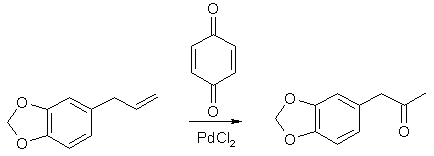
  3. I used the Wacker reaction to make MDP-2-P from the safrole.
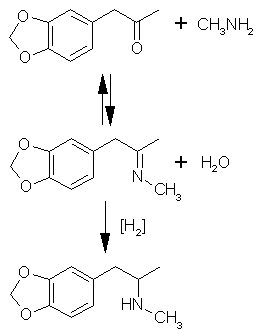
  4. I made MDMA from the MDP-2-P and the nitromethane.
  5. I took the ecstasy. This step was more fun than all the other steps put together!
Safrole:
There seems to be no problem with the distillation of the safrole from the raw sassafras oil using Bright Star's recommendations.
If a ¾ horsepower pool pump is used, it appears that the temperature at which the safrole comes over is about 106-107°C on the first pass. For the second pass, I used a vigreux column in addition, and the safrole came over at between 94°C and 99°C. Good vacuum! The pump basically recirculates water through an aspirator as fast as it can using water in a 5 gallon plastic bucket. To get a higher vacuum, there was always ice in the bucket. Thus the temperature of the recirculating water was always 0°C (unless I ran out of ice).
There are a couple of photos on the web of designs for good vacuum pumps that recirculate water. I mounted my pump to a board and then attached pieces of PVC pipe to make an output that sprayed into the bucket, and an input that sucked water from the bucket. I did not, therefore, need to drill any holes in the bucket as was proposed in at least one of the web designs.
The suction also seemed to be vastly better if there was a baffle in the plastic bucket to keep the air bubbles from getting sucked into the input of the pump. I used the lid of the bucket as a baffle and crammed it down vertically between the place where the water from the aspirator fixture sprayed in water/bubbles and the input pipe from the spa pump sucked it out. This uses ice very quickly -- without ice, it's amazing how fast a ¾ horsepower motor heats up 4 gallons of water. By the way, a ½ horsepower motor should be sufficient; I just happened to have one rated at ¾ horsepower.
Also, always run ice water through the distilling column, either when distilling or when you're using it as a reflux column.
Distilled the sassafras over peanut oil in a 1000ml flask in 2 passes. The result was about 700ml of safrole from 1 quart of sassafras oil.
Nitromethane:
Bought nitro fuel for RC engines at a model hobby shop. The bottle said it was 40% "nitro" (= nitromethane), but after my distillation, I doubt it. It seemed to be at most 30%. Had to do a fractional distillation using a vigreaux column. The fuel is a mixture of methanol, nitromethane, and castor oil.
Note by Rhodium: This discrepancy is probably due to the fact that methanol and nitromethane forms an azeotrope. First a 92:8 MeOH/MeNO2 mixture (bp 64.5°C) distills over (close to the boiling point of pure methanol, bp 64.7°C) and when all the methanol is gone, the temp shoots up to ~100°C, where pure nitromethane is collected.
Nitromethane boils at 101°C, so I had to do it over cooking (peanut) oil instead of water. It seemed to come over at about the right temperature, but it's OK to have a mix of the nitromethane and some methanol, since the only time the nitromethane is used is in a mixture that uses methanol as a solvent, and the total amount of methanol is unimportant, so some extra is OK. If there is some methanol, however, it may be important to add a bit of extra nitromethane/methanol to be sure to get enough nitromethane, since that's critical to making the final product. I used about 10% or 15% more of the mix for that final step and didn't have any problems.
What I did was to distill for a long time to get almost all of the methanol out, and then, when the temperature spiked up to near 100°C, I let that run for a few seconds, then switched to a new flask to get the nitromethane.
Did I mention that this distillation scared the shit out of me?
What frightened me about the nitromethane is that the Merck Index says that it has a "flashpoint" at 112°F. I don't know what a flashpoint is, but I didn't want to find out! Nitromethane is the "nitro" in "nitro-burning dragsters" -- you know, those drag-racing cars with all the flames coming out. Note that the flashpoint is far below the boiling point (about 101°C) of nitromethane.
Note by Rhodium: This is not something of concern. The flash point of a substance is simply the lowest temperature at which you can ignite a substance. Gasoline has a flash point at several tens of centigrades below zero for example. It does not mean that the compound will spontaneously ignite or detonate, just that you should avoid sparks or open flames (which is a good rule at all times in a lab).
I tried to distill with a vacuum, and it was very difficult with boiling stones, since there would be a huge "bump" as a huge chunk boiled at once, which reduced the pressure, which had to build up for another huge bump. I did not have my hotplate/stirrer at the time, so I couldn't tell exactly at what temperature it was boiling, and the temperature was all over the place. Next time (if there is a next time), I'll try the vacuum distill, but with the stir-bar twirling like a dervish, and I'll use a vigreux column crammed with glass beads for a good fractional distillation.
Note by Rhodium: Distillation of nitromethane at atmospherical pressure is not inherently dangerous as long as you aren't distilling it all to dryness. It is not practical to vacuum distill nitromethane, as there is too much loss of product down the drain (using an aspirator as vacuum) or into your pump oil.
MDP-2-P (the "ketone"):
Used Methyl Man's "Benzoquinone Wacker Oxidation of Safrole in Methanol".
I tried the long-term stirring of the PdCl2 in methanol for 6 or 7 hours before adding the water and the p-benzoquinone. You can get the p-benzoquinone and PdCl2 from photography supply places. I mail-ordered mine from a Canadian lab (I thought this was great, too, since I'll bet the DEA has a harder time looking at Canadian lab records). PdCl2 is expensive -- like $25 per gram.
I never needed to add heat -- just a slow addition and then a long wait afterwards (8 hours to be sure everything reacted). Stirred the whole time.
I used gravity filtration in a coffee filter to get rid of the hydroquinone, and then put the filter in a zip-lock bag and squeezed it to get out the last drops.
When I washed with the sodium bicarbonate, I had a lot of crud on the interface between the DCM and the methanol fractions, but it was workable. The saturated NaCl made a real mess -- emulsion-like that just wouldn't separate. I finally froze it to break it up. I only did one NaCl wash since it was such a pain. Maybe it would be better not to shake the mixture so hard in the separatory funnel. Or maybe it would be better to use distilled H2O for the mixes. Or both. Next time, I'd use only distilled H2O for every place I need water, and I wouldn't shake so hard on this wash.
I did distill in two steps -- DCM over water without vacuum, then the MDP-2-P under vacuum over oil. Did it with a stir-bar and it worked OK unless I lost vacuum. Stir bar works much better than boiling stones, especially under vacuum.
I had problems cleaning the RBF afterwards, due to some charred shit. I read later that the best way to clean this is to add some paint thinner (mineral spirits) and clean with that FIRST, before you try stuff like soap and water (and strong acids, strong bases, et cetera). I do know the mineral spirits don't work so well afterwards...
MDMA:
Used Methyl Man's "Reductive Amination of MDP2P with Al/Hg + Nitromethane".
The reason I used this approach is that I was totally unable to make the methylamine hydrochloride (methylammonium chloride, MA.HCl) by any method. I tried BrightStar's method, as well as about 4 other methods I found on the web. In all cases, I was able to make what were probably mixtures of MA.HCl and ammonium chloride, but I couldn't figure out how to assess the purity. I also didn't have any luck getting the stuff I needed to do a purification: absolute ethanol is difficult to obtain; in California, the best you can purchase at a liquor store is about 75%, so you're faced with a distillation even to get to 95%. Then you've got to get some anhydrous calcuim oxide, and I didn't know how to do that. I even made a bunch of chloroform to clean out other impurities (which you should do), and that was a pain in the butt and perhaps a bit dangerous, too.
The problem is that the ammonium chloride will cheerfully react by the same mechanism as the MA.HCl with the MDP-2-P, but it will make MDA in place of MDMA. I would not have minded a mixture of, say, 3% MDA and 97% MDMA, but I just didn't know what I'd get. Anyway, the method described below worked perfectly, and should make exactly 0% MDA and 100% MDMA.
At first I didn't have a 2 liter, 2 necked RBF, so I did half-batches in a 1 liter flask, and that worked great, except that it took, of course, twice as long. There was never a problem with run-away reactions, and I always got a happy result. The full version is a little more tempermental, left more aluminum junk, but worked fine, too. Do this reaction at the end of the day, and let the final stuff sit around all night to make sure the reaction is complete. If you try to do it after just, say, four hours, there will be some aluminum fragments that are still bubbling in the NaOH, and these are a real pain in the butt during the separations. Wait overnight and everything is cool...
I used not only heavy aluminum foil, but the "Extra Heavy Reynolds Wrap". You can just cut 3 inch strips from the roll and put them through a paper shredder (to make pieces that are 3 inches long and ¼ inch wide) -- this is much easier than cutting them by hand. You'll have to do some dicking around with the coffee grinder to figure out how much of the foil strips can go in at once and not jam the machine. Even with the paper shredder and coffee grinder, it takes surprisingly long to make enough little foil balls to run the reaction.
After the reaction, I poured the grey sludge into large (gallon-sized) bottles, and added the xylene (xylene works fine instead of toluene, by the way) to the bottle. Then I did all the shaking in there before pouring the stuff in a separatory funnel.
I tried the washes with tap water and there was always a lot of gunk. On my final pass, I used distilled H2O in all steps and things were MUCH better. The moral: use distilled water, don't use tap water!
When you are drying the epsom salts (do this well ahead of time), don't put too much in the oven at once. I put a thin layer on a sheet of aluminum foil and cooked it very hot (400°F) in an oven for an hour or so. I made a bunch of batches and kept them sealed tightly in a jar. I also ground the stuff to a powder using a mortar and pestle. I might try a coffee grinder next time. Don't try to cook up too much at once -- this can make a horrible mess.
I used a hair-dryer to dry the bottles that were to contain the anhydrous stuff (after the acetone wash, of course).
I had two bad experiences with HCl generators before I figured out how to do it. This is the way: Add NaCl (lots, non-iodized) to a two-necked flask. A big one (2 liters) is good. Wet the NaCl with HCl, but not too much (no puddles).
Plug a vigreaux column with glass wool (cut from a heater filter), and pour the column full of CaCl2 (Damp-Rid pellets). Then put the thermometer adapter with a tube instead of a thermometer mounted in it into the top of the column.
Into the other neck of the main flask, put in an addition funnel with concentrated sulfuric acid. All joints should be greased with silicone lubricant. Drip in the H2SO4, and anhydrous HCl gas comes out the tube. Do this outdoors -- you're going to get clouds of HCl gas, which you certainly don't want to breathe. Use the silicone grease throughout.
Even at the end, when I thought there were no longer any mistakes to make, I screwed this up. I tried to powder the CaCl2 to get better surface area, and then tried to pump through too much HCl gas too quickly. The powder was too fine, it plugged the gas, and finally a giant belch of gas, H2O, and CaCl2 was dumped into the xylene and it totally fucked up the batch. TAKE IT EASY AND SLOW WITH THE GAS GENERATION. You have plenty of time, and it's the last step.
TEST THE TUBE AND EVERYTHING IN XYLENE BEFORE YOU TRY IT FOR REAL! I found, to my horror, that the "aquarium rock" that I added to the end of the tube to make lots of tiny bubbles dissolves in xylene. I had great success with nothing but a hollow tube.
Don't be a pig -- when you get a bunch of precipitate, run it through the filter and then re-gas. It's even better to chill the xylene mixture to drive out more precipitate. At some point, usually after about 3 gassings, the stuff in the xylene starts getting a yellow tinge and then starts to stink like HCl (maybe water in the xylene?) Anyway, I did it in three passes, and as soon as I saw a tiny amount of yellow, I quit. You can use the slightly yellowed stuff -- wash it with acetone, but the more yellow and the more stink, the more of the real product seems to disappear and be dissolved in the water.
When you get the final stuff -- MDMA mixed with xylene -- get as much xylene as you can out of it on a vacuum filter (returning the xylene, possibly, for another passing of the HCl gas). Then, over the vacuum, put in a few jolts of acetone. This dissolves not only the yellow crap (if there is any), but tends to pull out the xylene and things dry quite rapidly.
I got (on the time I made the fewest errors) about 18 grams of MDMA (dried from the acetone) from 25 ml of ketone.
I did not recrystallize this "raw product", since it looked snow-white to me. It does have a faint odor (safrole?) but very faint.
Note by Rhodium: Even if your product looks pure and snow-white to you, please do yourself and your friends a favor and recrystallize the product. A lot of unhealthy byproducts are white/colorless just like pure MDMA, so visual inspection cannot be used to verify purity (you can only verify the presence of colored impurities). Pure MDMA·HCl is odorless, so using your nose is a better way to gauge purity.
The bioassay was extremely successful (I tested perhaps 120mg of acetone-washed product on a human subject weighing about 170 pounds).
Making Doses:
This was a pain. What I finally wound up doing was to take the pile of dried stuff, chopped it with a razor, crushed it with a piece of shiny plastic, chopped again, and got pretty good dust. Then I packed the dust in the most consistent repeatable possible way into capsules. Then I counted the capsules, weighed the whole mess, then weighed that many empty capsules. Thus I determined the dose for each, and wrote that down with the capsules.
Although it's obviously an approximation, if I know that the average capsule in a batch contains 270mg of MDMA, I can pour out that capsule on a sheet of glass, chop it with a razor, and form the powder into a fairly uniform rectangle. Then it's easy to cut out roughly what I want. If you divide the 270mg into thirds, you know that each is about 90mg, et cetera.
A method to measure a known quantity is with an empty capsule and a cylindrical stick or something to pack the stuff solidly into the bottom. I used a drill index and was able to find a perfect sized drill bit for my capsules. Then you can measure the height of the stuff in the capsule pretty accurately.
I made a big error the first time I was loading a bunch of powder into capsules. It took a fair amount of time, and I took a bunch of breaks. I couldn't bear to wash that beautiful white powder off my fingers each time, so I licked them clean. I have no idea what my final dose was that day, but I know it was higher than anything I've taken before or since. The next time I was fairly anal about doing the whole job all at once, followed by a single final lick, (and then 120mg from a capsule, just to make sure).


Complete MDMA Synthesis by Bright Star

This file is a part of the Rhodium site archive. This Aug 2004 static snapshot is hosted by Erowid
as of May 2005 and is not being updated. > > Back to Rhodium Archive Index > >

A Complete MDMA Synthesis for the First Time Chemist

Compilation and Editorial by Bright Star

HTML and Pictures by Rhodium

Introduction

Thanks to Strike, Rhodium, Ritter, Osmium, r2d3, Semtex Enigma, Spiceboy, ChemHack, Labrat, Eleusis, Ketone/LabGrrrl, and a personal hero, Dr. Shulgin. And to the object that made this possible - the Internet.
Disclaimer: This is for theoretical argument only. IF someone chooses to follow this synthesis, note that the product has been 'Scheduled 1' by the United States Government, and offenders can be prosecuted. In no way do I condone this activity.
This is a hypothetical synthesis for: 3,4-methylenedioxy-N-methylamphetamine. Or MDMA.HCl. Or Ecstacy. The synthesis as described 1. does not put off nasty fumes, 2. doesn't require suspicious chemicals, and therefore is 3. perfect for the clandestine chemist. The synthesis itself can be performed in a series of weekends or in a straight shot. If one were to follow this exactly - with no shortcuts - buying everything they're told - doing exactly what is written - they and they're friends will have a lovely spring. For those who think they are better than the instructions as written - be prepared to screw it up at least 4 times before success (or you finally figure out I'm right). Be prepared to invest ~$800. Be prepared to read and learn. It's also a good idea when investing in chemicals to buy 5x what is needed for a synthesis - this way you can repeat it without buying it again. Read the whole thing before you start. There is some prep-work that can be done ahead of time, or while you're distilling. Good luck.

Overview:

  1. Distillation: of Natural Oil to obtain pure Safrole
  2. Rxn: Formaldehyde + Ammonium Chloride -> MethylAmine.HCl (MeAm.HCl)
  3. Rxn: Safrole -(Wacker Oxidation(PdCl2+Benzoquinone))-> MDP2P
  4. Distillation: of Reaction contents to yield pure MDP2P
  5. Rxn: MDP2P -(Al/Hg Amalgam (MeAm.HCl) -> MDMA oil
  6. Crystallization: (MDMA oil + HCl in IPA/Xylene) (anhydrous conditions)

What you need:

This list is the basics. Do not even start this without ALL the Chemicals and Apparatus.

Apparatus and Glass:

  • 'The Organic Chem Lab Survival Manual' by James W. Zubrick. (A must, throughout this text, pages from this book will be mentioned. ~32$) (and very handy pictures of glass set-ups)
  • Distillation Apparatus (1x500mL and 1x1000mL Round Bottom Flask, 1x250mL Round Bottom Flask, condenser, distillation adapter, vacuum adapter, thermometer adapter) (Get Ground Glass Joints. These are the best. 19/22 or 24/40 - my first set was 19/22 - and is still used to this day.)
  • Thermometer (0°C to ~300°C)
  • Stand (Home Depot - (2x10in., flange, 2 ft. of ½in pipe))
  • Clamp (Buy it. Trust me its worth it) (for holding the glassware to the stand - these support several hundred dollars in glass - buy a nice one!)
  • Hotplate/Stirrer combo (got to have it, its worth it) (www.labx.com - spend $200)
  • Magnetic stir bar (look on the Web) (teflon coated)
  • Water Aspirator (or a good vacuum source. But aspirators are cheap <$20)
  • Boiling Stones (for distillations. Small shards from a broken coffee mug)
  • Tubing (about 10ft. total (3 meters) - hardware store - vacuum tubing is better than dialysis tubing - but both will work)
  • Vaseline (not much - for coating of the ground glass joints)
  • Measuring Cups (Prefably pyrex, and in milliliters (mL))
  • 10 various sized glass containers/bottles (250mL, 500mL, 1L, 2L etc)
  • Scale (a three beam analytical balance are great - and can be found for less than $100 - www.balances.com - they can weigh as much as a kilo and as little as 0.1g - perfect!)
  • pH paper (chemical supply) (just one roll will do - ~10$) (nothing specific, just need to tell the difference between an acid and a basic solution)

Chemicals:

  • Safrole (160g)(sassafras oil, yellow camphor oil) (Natural/Essential Oil distributor)
  • Dimethylformamide (DMF) (350mL) (Diethylformamide or Formamide will work)
  • p-Benzoquinone (Quinone, Benzoquinone) (120g) (Photo Shop, or Chem supply)
  • Palladium Chloride (PdCl2) (2g) (Photo Shop, or chem supply)
  • Methylene Chloride (DiChloroMethane, DCM) (this can be distilled from automotive solvents (just go into Nationwise, PepBoys, Sears, AutoZone And read the labels) Or a Liter can be bought from a Chem supplier.)(Zip-Strip furniture polish remover)
  • Hg salt (1 gram of: HgCl2, Hg(NO3)2, Hg(OAc)2, HgCl, It can be anything, and 1g should last you a long time.)
  • Isopropyl Alcohol (IPA, Pharmacies 91% Isopropyl Alcohol will be available)(get +3L)(don't get the 70% stuff) (or you can get pure stuff from a chem supplier)
  • Epsom Salts (Magnesium Sulphate) (MgSO4) (grocery store/pharmacy) (Spread out on a cookie sheet, and bake in the oven at 200°C for 3hr to dry them - pretty useless if you don't dry it)
  • Thick Al foil (heavy duty, or pie pans from the Grocery store)
  • Muriatic Acid (31.45% HCl)(Pool pH down, Driveway cleaner, ~3$/gallon)
  • Sodium Hydroxide (NaOH) (Drain Cleaner Crystals) (Read these labels, Get the stuff that is JUST NaOH.) (Red Devil Lye, Lye - Hardware Store)
  • Ammonium Chloride (NH4Cl) (Photo Store or Chem Supplier)
  • Paraformaldehyde (Hardware store) (called Mildewcyde or DiGas - made by the same people who brought you Damp-Rid - hint-hint)
  • Peanut oil (this is a high boiling oil that we will use as an oil bath on the hotplate/stirring plate combo)
  • Acetone (for cleaning your glass and crystal work-up) (Paint Section of Hardware Stores)
  • Xylene (for crystallization) (paint section - thinner - get it specifically)

Step 1. (4 hours)

1. Distillation: of Natural Oil to obtain pure Safrole.

A Comprehensive Description of This Step by Chromic
Set up for a vacuum distillation like on page 53 of Zubrick. Always put a little Vaseline on the ground glass joints - this way they won't stick when you try to take them apart. Put as much Natural oil (Sassy, Camphor, ect) as you have, but not more than 300mL, into the 500mL Round Bottom Flask (RBF) with several Boiling Stones. Put one of your 250mL RB flasks as the receiving flask. Set up your Water Aspirator Vacuum, in the sink (this may require setting this up a day before - parts, trips to the plumbing store, etc.) and attach the vacuum hose to the aspirator and then to the vacuum adapter on the distillation set up. Start turning up the heat slowly! SLOWLY! The slower you do it, the better/purer your safrole will be. At normal pressure safrole boils at 232°C - but under your vacuum, it may boil at anywhere from 110-160°C. Whatever temp it starts to come over at - make a note of it. And if the temp is higher than 160°C - check your seals on the tubing and glassware - More than likely there is a little leak. Remember that Vaseline! At the end of the distillation, you should have a water white oil that really refracts light - And has a lovely smell - a little like potpourri.
Distillation set-up: Set up the distillation set-up on your bed, before you try to put it together on the stand. You will get a good idea about how the pieces go together, and become familiar with the fragility of the whole thing. Read Zubrick for advise about where to place the clamp.
The Peanut Oil: A bowl with a flat bottom rests on the Hotplate. It is filled with Peanut Oil. The distillation flask sits in the bowl but not touching the bottom, so that the Hotplate heats the bowl, the bowl heats the Peanut Oil, the Peanut Oil heats the distillation flask. This is VERY effective. And will be perfect for all your distillation needs - especially if you do it under vacuum.

Step 2. (2 hour work + 4 hours wait + 4 hours work)

2. Rxn: Formaldehyde + Ammonium Chloride -> MethylAmine.HCl


In your 500mL RBFlask: Set up for distillation (not vacuum). In the distillation flask (your 500mL RBFlask) put: 108g of NH4Cl, 120g Paraformaldehyde (molecular ratio 1:2, remember this when scaling up!) and 320ml of water and several boiling stones. Start heating very SLOWLY. Remember to turn on the water in the condenser!
At 80°C a clear solution was obtained. Heating continued - The temperature was maintained for four hours at 104°C (this temp is VERY important - if you over shoot it - don't worry - bring it back down and try to stabilize it at 104°C) Once you've got it at 104°C start the stop watch and do it for 4 hours. At 104°C, a small amount of distillate will come over - very slowly - this is good. We are removing methylal, and methylformate from the reaction contents and therefore driving the reaction to the right - or getting more of what we want.
After four hours and while the solution is still hot, set up to vacuum distill (IE its already set-up - now just add the vacuum hose!) - but don't turn on the vacuum yet. Turn up the heat. Within 30 minutes or so - liquid should start coming over - the internal temp of the mixture should not go over 200°C - Keep distilling off the liquid until ½ of the solution remains - (IE distill off half of the solution.) Then, take your flask off the Hotplate and let it sit in an ice/water bath. Crystals should start to form in several minutes. Filter off these Ammonium Chloride Crystals. Now set up for distillation of the remaining liquid again - Add a couple more boiling stones. Distill off half of the remaining liquid. When half remains (or a ¼ of the original solution), turn the vacuum on SLOWLY! VERY SLOWLY! - you don't want the whole mess of liquid jumping out at you. At some point the whole mass will crystallize into a yellow-white solid. This is ~95% MethylAmine.HCl, ~2% Ammonium Chloride, and 3% DiMethylAmine.HCl. This is fine for the next step. It may be a little wet, but if you let it crystallize hot (spontaneously in the flask with heat) it should be fairly dry. Seal it in a wide mouth jar until needed.
As a way to check your product - if you live in a relatively humid area, you can put a crystal of your product on the table - walk away - and when you come back a small puddle of water will be on the table where your product was. MethylAmine.HCl is said to be HYGROSCOPIC. Another way is to put 20mL of water in a cup then add 5g of the NaOH to it. Stir to dissolve. Now, drop several crystals of your product into it - it should smell like rotting fish + ammonia. If you do the same with Ammonium Chloride, it will just smell like ammonia.
You'll recover about 1/3 of the ammonium chloride for recycling and after a lot of evaporating. You'll get ~80g of pure (95%) MethylAmine.HCl, which corresponds to ~80% yield. Congrats. This can be stored at room temperature, forever. I've heard of people using 40+ year old MethylAmine.HCl with excellent results.
Paraformaldehyde is the polymerized form of formaldehyde - but unlike most polymerization processes - this one is reversible - so Paraformaldehyde and formaldehyde can be interchanged at will. If all you can get is formaldehyde solution - remember that if its 37% formaldehyde then 100g of the solution contains 37g of formaldehyde - or just go ahead and change your amounts in the flask to - 324g of 37% Formaldehyde Solution, 108g NH4Cl, 205mL water.

Step 3. (2 hours work + 7 hours wait + 1 hour work)

3. Rxn: Safrole -(Wacker Oxidation (PdCl2+Benzoquinone))-> MDP2P

This step has been called the Wacker Oxidation. It uses PdCl2 as a catalyst to put and oxygen across a double bond. This step has been worked over many times so do not change the amounts for the fabled 'scale-up'. If you do this correctly, you will have more MDMA.HCl than you know what to do with. (Thanks Strike!)
Procedure:
Put the following into your CLEAN 1000mL RBFlask:
300mL of dimethylformamide (DMF), 50mL of tap water, 120g of p-Benzoquinone 2g of Palladium Chloride (PdCl2), Magnetic Stirbar. (PS - Don't skimp on the catalyst!)
Start the stir bar on 'slow stir'. Mix 160g of Safrole and 50mL DMF in a cup/jar. Drip the Safrole/DMF Mix into the solution at room temp (30°C) over 30min time. After the addition, the solution was dark reddish orange. Almost black. Make sure the stir bar is spinning - Now - Walk away. Go to bed. Go somewhere else. Set your watch alarm to wake/remind you 7 hours later. Note: This reaction requires NO additional heating! Just stir!
Strikes comment: "After 4.5 h the solution will progress on its own to 45°C. Obvious exothermic reaction. After 7 h solution will be back to ~30°C."
The reaction mix was flooded with slightly acidic water (~50mL of Muriatic Acid (HCl) in 1.5L of water). The oil fell out of solution to the bottom. It was black/blood red in color. This is when its nice to have a Big Sep Funnel.
Now we need to define several things. The upper layer (in this case!) Is the aqueous layer - IE it's the layer that contains the WATER - the bottom layer is the organic layer (in this case!). IE it contains oil and other ORGANIC type molecules (IE the stuff you want!).
After you flood the reaction contents shake the container to mix the solution, give it about 10 minutes to settle - two layers will form. The upper aqueous layer was a lighter blood red/pink. The upper aqueous layer was decanted from the oil (IE it was poured off). The aqueous Layer washed with 2x100mL DCM (Methylene Chloride / DiChloroMethane). If you can't see the layers, hold the container up to the light, so that the light shines through the container. Keep the DCM washes - They contain the goods.
You now should have about 200mL total of DCM washes. You should also have about ~100mL of the 'Organic Layer' that you separated from the reaction contents. Pour the DCM washes and the Organic layer together. Now wash the DCM/Organic layer with 2x150mL 10% NaOH (30g NaOH in 270mL water). This will remove the other reaction by-product - hydroquinone. If you don't do this step the hydroquinone will clog your condenser when you try to distill. Keep the DCM/Organic layer. The NaOH layer (Aqueous: is still on top) can be tossed. (Thanks Osmium!)
You can stop here and wait for another day - put the DCM/Organic Layer into the freezer.
Define Washes - 100mL of DCM was poured into the aqueous layer and then the aqueous layer+DCM was shaken so the two would mix - then it was put down to let it settle out again. When it was settled (notice that the layer now is a different color) the aqueous layer was poured off again into another jar where it was washed again with another 100mL portion of fresh DCM = 2x100mL washes.

Step 4. (4 hours work)

4. Distillation: of Reaction contents to yield pure MDP2P

Pour the DCM/Organic layer into your CLEAN 500mL RBFlask. Put several boiling stones in too. Set up for vacuum distillation.
This time we are going to collect a particular fraction in the flask - there is DCM (BP 40°C), water (BP 100°C), DMF (153°C), safrole (232°C), ketone (BP est. ~290°C), and polymerized crap (BP ~300°C+)
Now remember when we distilled the safrole? What temp did it come over for you? Well - that temp plus approximately 25°C is the temp that the ketone will come over under vacuum. For example, if your safrole comes over at 150°C, then the ketone will come over at 175°C. If your safrole comes over at 130°C then your ketone will come over at 155°C. Get it?
WEIGH the receiving flask! Write the weight on a piece of tape and tape it to the flask!
Start your vacuum distillation by first turning on your vacuum - if you remembered your boiling stones, then it will begin to boil immediately. This is the DCM coming off first. The boiling may be very vigorous, So watch it, and be prepared to vary the pressure so it won't fly into your receiving flask. Turn on the heat (Hotplate) SLOWLY! and let the temp climb to just over the temp at which safrole came over (SLOWLY: it should take at least 2 hours to reach that temperature - if you do it in under 2 hours you are going WAY to fast). You are going to have to change the flask, when the temp gets to above the safrole temp. This is a bit tricky, because you are going to have to release the vacuum. Release the vacuum at the pump/aspirator and change the flask quickly - you may just dump it out, rinse it once with acetone, or IPA (IsoPropylAlcohol) - and put it back. Start the vacuum immediately, but be careful here, because the Organic layer that you are distilling might jump out of the flask and into the receiving flask - so if you can - vary the vacuum so that the vacuum comes on GRADUALLY! (IE with an aspirator, turn on the water slowly.) The ketone oil is a clear white/yellow hint of green oil. Re-weigh the flask for your yield calculation - you should have over 100g of ketone.
With an aspirator you can vary the vacuum when you are turning it on. You simply turn on the water slowly. IE Increase water pressure slowly. By turning it off, you can make water jump into the receiving flask because there is a 'vacuum' in the distillation apparatus and it will suck water out of the aspirator - SO - when you turn off the vacuum, do so by removing the hose from the aspirator - while the aspirator is going. You can also vary the vacuum by removing the hose PARTIALLY - This will take some practice so play and have fun.
Strike's excellent post read: "With high vacuum at 100-140°C ~18g safrole came over. At 166°C came over ~125g ketone." When she did this method...
Keep the ketone. Smell it. Look at it. Look at how it refracts light. For the brave: taste it. Note all of these 'properties' and remember - After you have judged its properties, put it in the freezer. Note: it won't freeze. It will become a very viscous liquid.
If you try to distill the ketone at atmospheric pressure (no vacuum), you will get to about 220°C and then the whole flask will polymerize. Total waste of effort, time, and precursors. So don't mess around and get a vacuum source.
The ketone is unstable. It won't explode or anything, but if left to its own devises, it will rearrange. And then it will be useless. At room temp, it will rearrange in about a week - depending on where you live - if you keep it in the freezer - it can last months - FREEZER! After its in the freezer you can stop for today.

Step 5.

5. Rxn: MDP2P -(Al/Hg Amalgam (MeAm.HCl) -> MDMA oil

(Thanks Ritter, Osmium, Shulgin!)
This is called the Al/Hg Amalgam. This process utilizes the electronegative properties of the Aluminum. Now, something that most people don't realize, is that all aluminum is actually coated with Al2O3. This is the oxidized form of Aluminum. We will remove this part of the foil so that the aluminum can reduce the imine with elemental Al.
This reaction actually has two parts. First, there is the ketone imine condensation. This reaction reacts the ketone with methyl-amine to form an imine - water is produced as a product. Second, the imine is reduced (Hydrogen is added across the double bond) to the amine. The condensation really needs anhydrous (no water) conditions, and the reduction actually needs water - so there is a fine balance here - IE don't mess with the procedure.
What you need to have prepared ahead of time:
  • CLEAN 500mL RBFlask.
  • 20g of thick aluminum foil cut into ~1cm squares.
  • 0.1g of Hg(salt) (any mercury salt will do, not Hg Metal)
    (Note: Hg=Mercury)
  • Disposal Jug (milk jug)
  • 1L of Clean water
  • 25mL of 25% NaOH solution (dissolve 25g NaOH in 75g of water, then 25mL of it)
  • 50g of MethylAmine.HCl dissolved in 300mL of 91% Isopropyl Alcohol
  • 40g of 'ketone' dissolved in 50mL of 91% Isopropyl Alcohol
  • Cool water bath. (A milk jug with the top cut off)
  • Ice (don't screw around, buy a bag) (or have at least several kilo's handy)
Set up your stand and clamp so that, when the flask is clamped to the stand the bottom of the flask is about 4 inches (10cm) from the table top. This is so that you can put the heating plate and stirbar combo under it. Have your thermometer already in its thermometer adapter so you can throw it in the flask at any second.
Prepare the following, put them in a jar and have them ready at a moments notice:
  • 50g MethylAmine.HCl dissolved in 300mL 91% Isopropyl Alcohol
  • 40g 'ketone' in 50mL of 91% Isopropyl Alcohol
It is very important that these are ready before you start! Before you start! 20g of Al squares are put into the 500mL RBFlask. They are covered with ~350mL of H2O (water). 0.1g of Hg(salt) (or just a very small spatula) is placed in with the Al squares, and given a good stir. Amalgamation was allowed to proceed until there was the evolution of fine bubbles the formation of a light grey precipitate, and the appearance of occasional silvery spots on the surface of the aluminum. (Thanks Dr. Shulgin!)
Basically here the Al2O3 is being destroyed, the water is reacting with the Al2O3 to form Al(OH)3 and H2. This should take between 15 and 30 minutes. Just be patient.
When amalgamation is complete, pour out the water into the milk jug. Pour in another ~350mL of water and carefully shake the flask to stir up the contents. Pour it out into the jug. Do it again with another ~350mL of water. So basically, you wash the Al pieces with 2x350mL of water. Dump out as much of the water as you can in 10 seconds or so - then immediately go to the next step - leave the Al foil in.
This will remove most of the Hg from the solution. Don't worry, the Hg will be completely removed in the successive washes during the work up. If you let the Al squares sit in between washes, they will heat up and re-form the Al2O3 in a matter of seconds. So be quick and have the ingredients ready for the procedure.
Now, immediately, add in THIS order:
  • 50g MethylAmine.HCl dissolved in 300mL 91% Isopropyl Alcohol
  • 40g 'ketone' in 50mL of 91% Isopropyl Alcohol, then drop in a Magnetic Stirbar. Try to get the stirbar going - it might take several minutes.
Now drip this in 25mL of 25% NaOH solution over several minutes. Put the thermometer in the solution. Start being very paranoid about the temperature. The temperature of the reaction flask must not climb above 60°C. Its best if the temp is kept around 50°C. Stirring is necessary so, with the heat off, stirbar on, flask sitting in the cool water bath. When the temp gets to about 50°C, put several chunks of ice in the bath. If the temp falls below 40°C, take some of the ice out. But whatever you do, make sure the temp remains below 60°C. The whole time you are doing this the contents are a grey sludge. Remember to keep the stirbar going! If the stirbar is difficult to start going. Don't worry, trying to get it started seems to work just enough.
At some point you'll notice that the temperature is not rising like it had been (in about 4 hours or so). You have reached the end of the ketone -> imine condensation - Look inside the reaction flask and see if you still see any pieces of Al foil - if you do - continue stirring until the Al foil has been depleted. This reaction should go no less than 6 hours.
Now, after you are convinced that the reaction has stopped (6 hours later) - IE the temp of the solution is room temperature, and there is no more foil chips in the mix. Pour in 25mL of the 25% NaOH solution. Stir the contents some more, and then let the stirbar stop and then let the solution rest for at least 30 minutes. The NaOH solution will make that grey sludge into a filterable consistency. If you can't tell there has been a change in the consistency - put in another 25mL of 25% NaOH solution. The grey sludge should abruptly change from a uniform grey to a chunky white/grey blob. Then in a matter of minutes the whole thing will be resting on the bottom of your flask.
The reaction contents will settle out. The grey sludge will settle to the bottom, and a clear yellow liquid will rise to the top. Pour off the clear yellow liquid. Save it. Put 200mL of 91% Isopropyl Alcohol into the reaction contents, stir the solution, so that the whole thing is disturbed and swirling in the flask and again wait. Pour off the 2nd clear yellow liquid once it settles. Add the 2nd clear yellow liquid to the first. Do this several times, or until the clear liquid is no longer yellow.
This is an extraction out of the reaction contents. The more you do this process, the higher your yield. So don't do it once and get excited and try to complete it with just the first extraction because you will just waste half of your product. You've gone this far - don't fuck it up now.
After you have gotten as much of the yellow liquid out as you could. Put the grey sludge in the same milk jug waste container. Dispose of it properly - the milk jug contains elemental Hg - Not a lot - less than 0.1g. But you should dispose of it properly. Not down the sink. Take it to a High School or A University, To the Chemistry department - tell them you broke a thermometer, and then couldn't figure out what to clean it up with.
Set up for vacuum distillation (Boiling Stones!) but we're not going to distill. We are going to evaporate the Isopropyl Alcohol (IPA) from the reaction contents. Under an aspirator vacuum, the IPA should come over around 35°C. Make sure you get the alcohol out. When the alcohol is close to being gone - the solution might spontaneously separate in your distillation flask. Not to worry - the top layer is probably your product, and the bottom is water. Don't try to separate it, just dump the whole thing into the next procedure.
The next two paragraphs out line a procedure known as an Acid/Base extraction. This works very well for our target molecule, and any molecule that contains an amino group. If the next two paragraphs are not done, then plan on not having any crystals when you're done.
After the alcohol has all gone, Take the brown oil that is left and put it into 500mL of ~0.5M HCl solution (470mL water + 30mL of Muriatic Acid). Stir or shake it up. A lot of the brown oil should go into the acid solution. Now pour into this solution 30mL of DCM. Shake again and let it settle. You will notice two layers formed - The top layer is the Aqueous layer - which contains your product, and the bottom layer contains the DCM, polymerized crap, and non Nitrogen containing molecules. Pour off the top layer (That contains your product) and discard the DCM layer. Wash the Aqueous layer again with 30mL of DCM, and repeat the process. Note that the aqueous layer contains the product - Do not discard the aqueous layer! You can discard the DCM washes, because they contain nothing useful what-so-ever. Discard!
Now, slowly add 50mL of 25% NaOH solution to the aqueous layer. When you do this the Aqueous layer will turn a milky white and may heat up just a little bit. Not to worry. A light brown oil will fall out of the solution. This is your product (in the freebase form). Before collecting it, wash the 'now basic' Aqueous layer with ~50mL of DCM. Shake and let it settle out. Pour off the top Aqueous layer, and keep the DCM this time! The DCM washes contain the goods! Wash the aqueous layer twice more with 50mL of DCM. Combine those DCM washes that contain your product, and continue.
Set up for vacuum distillation, and once again, just boil off the DCM (Boiling Stones!). There might be a little water in it, so this time when you are boiling off the DCM, let the temp of the distillation flask reach ~50°C for several minutes. That should be good enough. You should have a light brown oil in the flask - it kind of looks like thick Newcastle Beer.

Step 6 (2 hours work)

6. Crystallization (MDMA oil + HCl in IPA/Xylene)

This must be done in anhydrous conditions. If its not, then you will not get crystals. Anhydrous means 'no-water'. If water is present, then you can expect to get crapola.

Procedure:

This first step can be done ahead of time. Like, during a distillation or reaction: Get a fresh bottle of 91% Isopropyl Alcohol, and pour out approximately 100mL. Now get some of your DRY Magnesium Sulphate (Epsom Salts) (about 100mL worth) and dump it into the 91% IPA. There might be a little heat evolution, but not to worry .... Shake it up and then let it sit till the MgSO4 settles out. Pour off the IPA, and then put more fresh MgSO4 into it (about 100mL worth). Now shake the bottle and let it sit for 15 minutes. You must do this at least three times - It really is much better to do it four times - Why fuck it up now right? After three times you will have 'Dry' IPA. You can actually do this while you are distilling or waiting for a reaction to proceed.
Make a mixture of 100mL 'Dry' IPA and 150mL Xylene. Pour it into the flask that contains the MDMA oil, and drop the stirbar in too. Stir so that the whole thing is mixed up real well - Now drip in Muriatic Acid slowly. Test with pH paper every 5 drops or so - keep adding the Muriatic Acid until the pH of the solution is 5-6 - or just barely acidic.
Set up for vacuum distillation, and distill the solution, distill this with the stirbar in instead of the boiling stones - IE When the solution has reached a pH of 5-6 - Start distilling. Be careful not to let the solution get above 120°C - When a lot of the solution has boiled away, crystals will spring to life in the flask. Under vacuum, the solution should never get above 70°C.
Filter these with a coffee filter, suspended over a jar - This gets the excess IPA/Xylene out. Scrape the crystals on to a plate and let the crystals dry, by letting the IPA/Xylene (mostly Xylene at this point) evaporate - this might take several hours - a 60 Watt lamp 6 inches (20cm) away from the crystals shining brightly helps. Stir the crystals to promote even heating.
The crystals will be a brown-yellow color. Now scrape the crystals into a jar, and pour ~20mL of acetone onto them. Swirl the mixture. The crystals won't dissolve - but a lot of the brown will. The brown-acetone is poured off, and the acetone wash is repeated.
After the acetone wash, dry the crystals. You should have around 15g of dry crystals. That's 150 hits. The now 'almost white' crystals have melting point values over the range from 145-153 ° C, depending on how much water was in there during crystallization. And these crystals are ready for consumption. 60mg is not enough. 80mg is great for my wife. 100mg is a great dose. 125mg is balls-to-the-wall. 150mg is too much. For me at least. Fun for me is actually 80mg MDMA+70mg MDA in one pill. WHOH. But I guess you'll have to do another synth - right?
If you have completed this, congrats. Fucking Fantastic. Now Teach Someone Else! If you do - we WIN! Dig it?

Purification of MDP2P via its NaI complex

-------------------------------------------------------------------------------
                           NaI Addition complex V1.0
                                   by Hellman
-------------------------------------------------------------------------------

Prebullshit.
Don't like distillation,??.
Want to have a 'no lab' police friendly home?

Ever tried the bisulfite addition, for that matter ever obtained sodium
bisulfite, instead of the meta bisulfite brewers special mix.? Well now the
confusion has come to an end, we here at hellman laboratories have had those
monkeys working hard, damn hard, just to make life a little easier for us
toothless nutctackers,.

Throw away your brewers concocktion, for his sturdier younger brother is here.
Yes, I'm talking NaI, Sodium iodide, this really is something you can make at
home, you see along time ago, a man came up with the bisulfite addition, well he
didn't come up with it, he merely read vogel's practical organic chemistry from
front to back,. If you look at the third edition book, somewhere on page 408,
you will indeed see where elusis's motivation came from,.

But, what he didn't tell us was that Nai will in fact I believe do a better job
at performing an addition product,. Well this ol' bee thoughT hmm,

Requirements
1) 60 grams red oily dirty ketone
2) 10 grams NaI( a huge excess to be safe)
3) some sort of half assed reflux apparatus

#note- one molecule of NaI connects with 3 molecules of ketone,you'll just have
       to work out the math for yourself.

Method.

One would place the ketone 60g into your reflux apparatus, then plonk in your
10g NaI, and then warm to reflux, as soon as it starts to reflux, dump the
beaker/vessel into cold ice/acetonewater to bring down the temp -8C, where by
little crystals will start forming, and the addition complex has been made,
filter of these crystals, and then relux again to see if more form.

Wash with toluene, filter, repeat, and your home with approx 20-40g NaIketone
depending on your method of formation.

to release your ketone simply add 300ml of water to the crystals, and gently
warm, the ketone should float to the top, and the NaI/water should remain on the
bottom, Pippete od the oil, and soldier on son'.

-------------------------------------------------------------------------------
vogels 5th edition,
TEXTBOOK OF PRACTICAL ORGANIC CHEMISTRY
New Edition: red cover
p 409

c) When only a relativly small quantity of pure, dry acetone is required, it may
be purified through the bisulfite complex: the latter is decomposed with sodium
carbonate solution, dried over anhydrous calcium sulphate then distilled.
A more convenient proceedure is to make use of the addition compound with sodium
iodide (NaI,3C3H6O), which decomposes on gentle heating and is particularly well
adapted for the preperation of pure acetone.
One hundred grams of finely powdered sodium iodide are dissolved under reflux in
440f of commercial acetone, and the solution is cooled in a mixture of ice and
salt(-8C).
The crystals are filtered off and quickly transferred to a dry distilling flask,
connected to an efficient condensor and to a reciever in cooled ice.Upon gentle
warming, the acetone distills rapidly.

(then the book goes on to say that it is also well suited to ethyl methyl ketone)

-------------------------------------------------------------------------------

Purification of MDP2P with Sodium Bisulfite

Purification of Ketones by Sodium Bisulfite

by Eleusis

So you've got this slop in a beaker that may or may not have that tasty little carbonyl compound that'll end up making some amine We Know And Love, but you've experienced disappointment in the past when trying to vacuum distill it. Maybe it's that hand vacuum pump you splurged for out of the Edmund Scientific catalog, or maybe you should try forming the bisulfite addition product instead. It is a somewhat well known fact that sodium bisulfite will add to the carbonyl group of a ketone to form a crystalline addition product. If the parent ketone is of large enough molecular weight, the product will be insoluble in water. The parent ketone can then be recovered at a later time by decomposition with sodium hydroxide. This is a doubly good trick in that it gives us an excellent way to get pure ketone from an impure reaction matrix and it also allows the long term storage of an otherwise unstable ketone prior to its use. Now, this doesn't *eliminate* the need for a proper (vacuum) distillation of the ketone, but it does make such a process much more pleasant in that when recovering from the bisulfite, there will be little tar and/or polymerized crap to deal with. This means greatly reduced cleaning for those precious flasks, and, possibly, higher yields. The bisulfite addition is a fairly general process, and may be adapted to many different ketones (keeping the molar ratios in proportion), however, there are going to be some ketones which will either not react or react to a low extent (mainly ones in which there is significant steric hindrance to the carbonyl carbon). In cases where the carbonyl carbon is on an aliphatic side chain to some other funky ring structure, there is little steric hindrance, and so the reaction proceeds quickly and nearly quantitatively. Finally, there is the limitation that that ketone (or ketone containing slop) be reasonably free of acidic or basic impurities, as these will interfere with the formation of the addition product. 1) Preparation of the bisulfite reagent (This must be prepared just prior to use, as it will autooxidize within hours if left to it's own devices.) Add 52g sodium bisulfite (NaHSO3, .5moles) to approximately 90mL of distilled water at room temperature with vigorous stirring (slightly more water may be used to get it all into solution). Add a volume of denatured alcohol of about 70% of the solution's volume (ie - if you end up with 100mL of solution, add 70mL of alcohol) then add more water to just dissolve the precipitate (~60mL). 2) Reacting with the ketone Slowly drip .25moles of ketone(*) into a beaker containing the bisulfite solution with vigorous magnetic stirring. The 2:1 molar ratio insures that all of the ketone will be converted. Let sit on the stirrer for an additional 30-45 minutes then filter on a vacuum Buchner funnel. Wash the crystals with 20-50mL of denatured alcohol. Dry in a vacuum dessicator or open tray then store in a stoppered glass bottle until needed. (*) If adding an impure reaction matrix, add as much solution as you expect to contain .25moles of ketone. 3) Recovering the ketone Add the ~.25moles of bisulfite addition product to a separatory funnel then slowly pour in 105mL of 10% Sodium Hydroxide solution (w/w). Separate out the aqueous layer (which may be on top or on bottom depending on the ketone), saturate with salt (NaCl), and extract with 50mL of ether (toluene or benzene ok if the ketone is of high enough bp). Combine the extract with the ketone layer and strip off the ketone by distillation (condense and reuse!). Distill the ketone residue, preferably under vacuum (if you're making what I think you're making), to yield up to 90%, depending on the purity of the starting ketone, of course. Refs to chase: A. Vogel, "Practical Organic Chemistry"

- eleusis@netcom.com - Bisulfite Ketone Purification Doc -

MDA from MDP2Pol; the Mitsunobu reaction

Novel Proposed Prep of MDA

by Eleusis

While surfing the library database (what most of you ought to be doing instead of cruising those alt.binary groups) I came upon a tasty little process of considerable academic interest. One of Dan Haney's little pets is the Mitsunobu Reaction, and finally I got around to looking it up. It deals with the conversion of alcohols to azides, which can then be conveniently reduced to amines with a variety of reagents (NaBH4 seems to be the most popular, but Al-Hg would surely do the trick). This is fine for producing heavy mixed aryl/alkyl systems, like MDA, but extremely hazardous for producing, say, methylamine, as the intermediate Methyl Azide is exceedindly unstable (ie - it tends to explode) and to make matters worse, alkyl azides generally boil at ridiculously high temperatures. Personally, I'd rather make HCN without a bodysuit, but then again... Some inventive and entrepeneurial chaps at the University of Newcastle-upon-Tyne in the UK came up with a one-pot process that goes straight from an alcohol to the amine hydochloride salt. You can't get more direct than that for some of those more interesting compounds. Unfortunately, this is not a viable way (as far as I can tell) to produce MDMA, or any other methylaminated compound, as it does not tack a methyl group on with it. The advantage in using this to prepare MDA is that it will not produce any di- or tri- aminated product, as an Al-Hg reduction (or any other similar mode of preparation) will do. As well, there is no need to supply ammonia either in salt or aqueous form, though would be the least of worries to me in the matter. The overview follows, with a reference to chase at the end.

Cognate Preparation, MDA from MDP-2-Pol [3]

1 Mole of MDP-2-Pol(1) (17.9g) is dissolved in 50mL THF in a 1L RB flask with magnetic stirring. 120mL of 1M Hydrazoic Acid (2) in Benzene (caution: highly toxic) is added, followed by 22.2g Di-Isopropyl Azido-carboxylate in 50mL THF. Next, a solution of 57.7g Triphenylphosphine in 300mL THF is added *carefully and slowly*. This will raise the reaction temperature, potentially considerably. Maintain temperature around 30-40C. After the temperature has returned to room temperature for 1 hour, heat the reaction mixture to 50C for 3 hours using a temp. regulated heating mantle. Add 10mL of water at this point, then continue heating for an additional 3 hours. Strip the solvents off under vacuum and suspend the residue (liquid freebase + impurities) in 100mL of methylene chloride. Shake this in a separatory funnel with 100mL of 2M HCl (caution!) to convert the amine freebase to the HCl salt. Draw off the methylene chloride layer (should be on bottom) and wash the acidic aqueous layer further with 2 x 50mL of methylene chloride. Pour the aqueous layer out onto glass trays heated by steam (improvise) to evaporate off the water, leaving the crystalline hydrochloride salt behind. The yield, I would estimate, should be around 65%, or .065 moles.

References

  1. Preparation of Hydrazoic Acid: Org. React., 3, 327, 1947
  2. Alcohols to Amines: Synthesis, Feb. 1987, pg 190-192
*DISCLAIMER* Remember, this is for academic purposes only.

- eleusis@netcom.com - Novel Proposed Prep of MDA - 1996/02/17 -